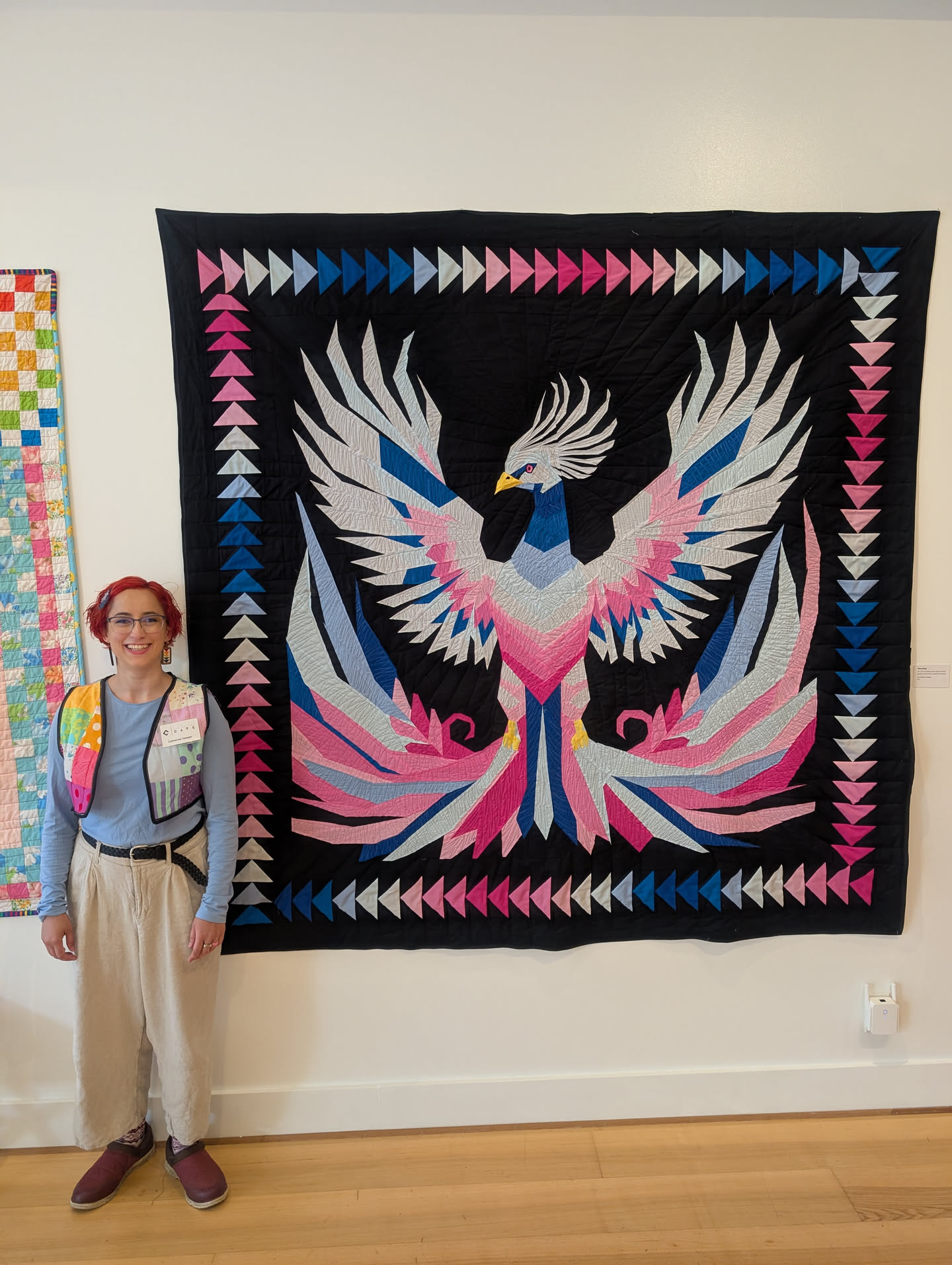
About Cat
Cat Sawyer is a quilter and pattern designer drawn to the possibilities of precision piecing that evokes feeling and wonder through color and design.
Cat began quilting through English paper piecing in 2019 and soon started designing her own patterns, using geometry and shape to create Escher-esque optical illusions. After discovering foundation paper piecing, Cat fell in love with its potential for turning drawn ideas into intricate, pieced designs.
She continues to explore pattern development across both techniques, with a focus on how thoughtful shapes and construction can bring an idea to life.
How a pattern gets made
I find inspiration and wonder in the "little" things in my life. As a lesbian, with many queer family members, the queer community is near and dear to my heart, and many of my designs are drawn from interactions from those people and communities. In other instances, an event such as driving to the store and seeing a particular mountain every day for a week, or a vacation where one particular hike happened - or even something as simple as my child getting a new toy that they're obsessed with - can all be sources of inspiration. Many times, getting that initial idea is the hardest part. Once that happens, the drive to create something with the idea is an almost tangible force, pulling me forward towards making a pattern.
With an idea in mind, I will often search through google images, comics, coloring books, comics, etc, looking for an image that has the general feel of the idea in my head. Colors, specific designs and motifs, etc don't matter nearly as much as "I'm imagining a bird, like the eagle on the US Quarter coin, with its wings spread adn a general feeling of joy around it". Whatever reference image I find will become the backdrop for my design. The process is one of refinement over time; I'll start with a reference image or images, play around in MS Paint a lot of the time to get the image closer to my imagination, and then start designing. The first design is almost always used as the new "base image" that I use to make the next iteration, and so on. (For those wondering, I lookk for reference images because... I can't draw. I have this bird in my head, and if I don't start with something at least resembling a bird, my shapes are all out of proportion!)
Once I have the design to a state that I like, a thorough review process ensues, in which I make sure that I haven't accidentally included or created any impossible shapes, Y-seams, or unnecessary single-piece foundations. I endeavor to make all of my patterns straightforward, easy to follow, and to make the best use of the medium at hand. I'm always open to suggestions, feedback, and/or ideas for future quilts!
Digital Design Tools
Most of my design is done digitally, in a program called Quilt Assistant (QA). It works phenomenally for FPP design work, but there's a lot of post-processing that happens as well. While I can name shapes and assign colors in QA, the pattern pieces that are generated aren't always perfect and need to be audited for correctness. Instructions for piecing order must be created manually, piecing diagrams and fabric amounts must be calculated. Some other tools I use for post-processing include Google Docs and Inkscape.
Techniques I work in
Introduce the two techniques in a sentence or two for readers who have never heard of them. Excepteur sint occaecat cupidatat non proident, sunt in culpa qui officia deserunt mollit anim id est laborum.
English paper piecing
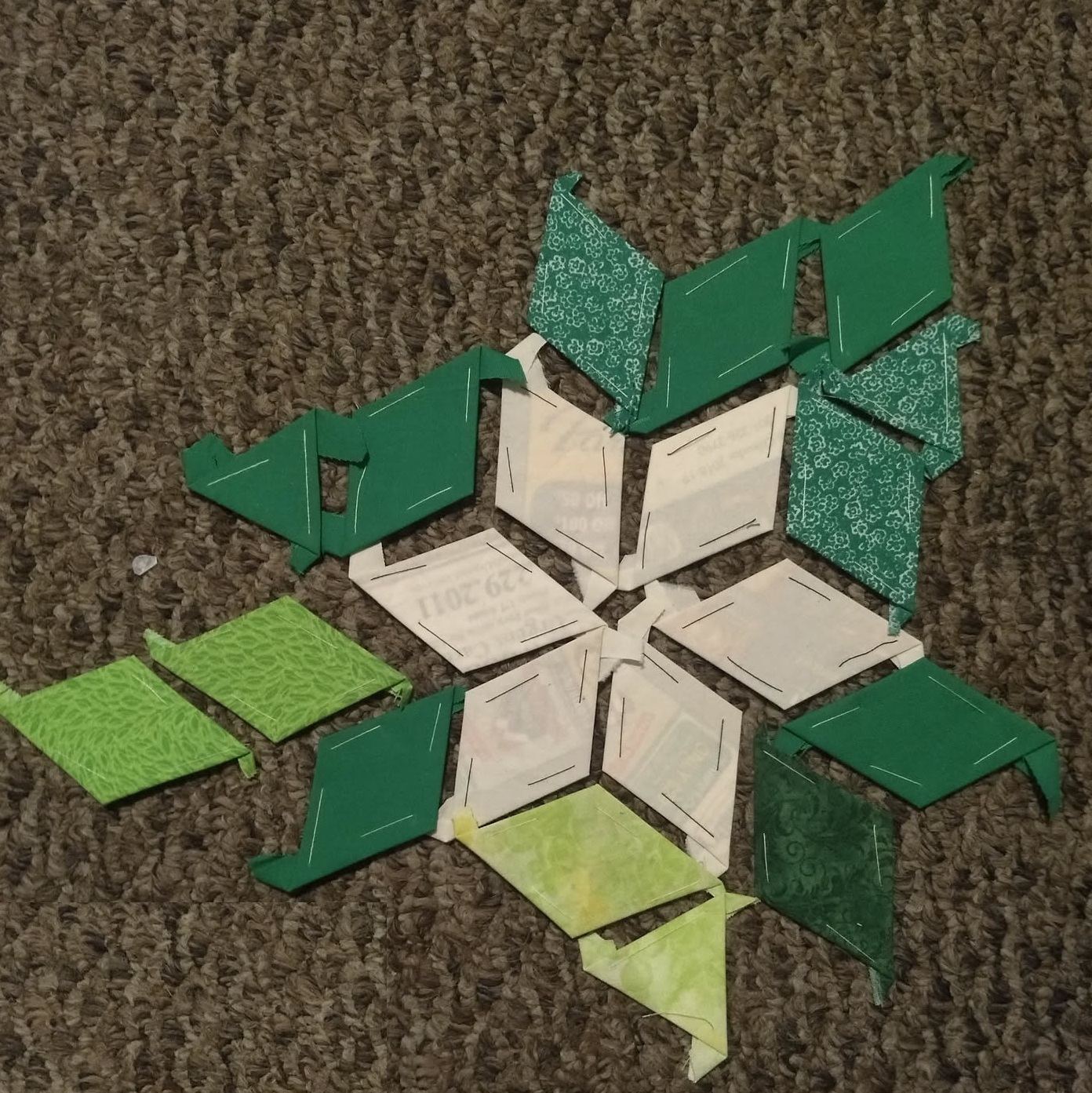
English Paper Piecing (EPP) is where I got my start in modern quilting. It allows for a shape to be cut out of paper (typically, one would buy a bag of 100+ copies of the exact same size and shape, die cut or laser cut to extreme precision). These shapes can be anything, but generally are shapes like hexagons, kites, diamonds, etc - shapes that can be difficult to manage in traditional piecing due to bias stretching and Y-seams. These paper (card stock) shapes are then wrapped in fabric, and the fabric is glued lightly or thread-basted onto the back of the paper shape. The fabric is then whip-stitched together into the shape or design desired. At the end, the papers are removed and the finished quilt top is revealed!
In this technique, seam allowance doesn't need to be exact, because the paper keeps everything very precicesly aligned. Many people use this technique as a way to showcase and emphasize their fussy cutting with even small pieces of fun fabrics able to become highlights of a pattern. For me, EPP because a playground of Escher-esque isometric geometric optical illusions.
Foundation paper piecing (FPP)
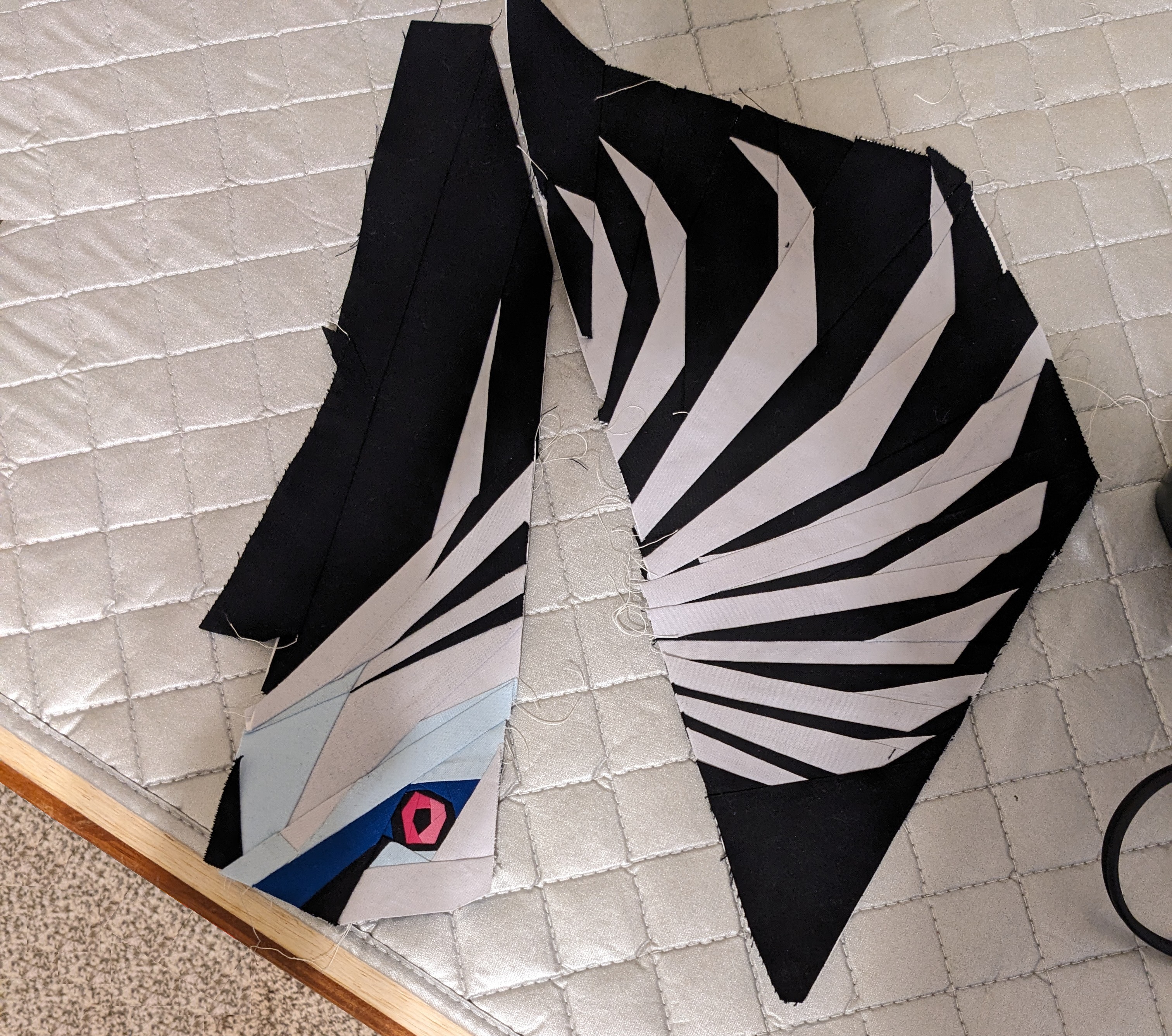
Foundation Paper piecing (FPP) is my primary technique in quiliting at this point. With FPP, instead of 'blocks' that are assembled, as you would find in a traditional quilting pattern, a series of 'foundations' are assembled by sewing fabric together on a paper foundation. Each foundation is designed to be pieced in a specific order. For a foundation A, A1 is glued into place on the paper, then piece A2 is sewn onto piece A1. Your 1/4" seam doesn't need to be perfect, because the seam allowance is trimmed after sewing. As long as you can sew along a printed line, you can do FPP.
One thing that can get people confused with FPP, especially as they are learning, is trying to use prints or other 1-sided fabric. While many absolutely gorgeous FPP blocks and quilts are made with prints, I always recommend that people new to the technique choose solids, batiks, or other 2-sided, non-directional fabric. This allows you to figure out how the pieceing, flipping, trimming, etc work, without worrying about whether you accidentally cut your fabric upside down.
What to expect from a pattern
All of the patterns that I sell are designed and tested by me. Where possible, I've also enlisted the help of several incredible volunteers to pattern test for me. My FPP patterns in particular are fairly advanced - by which, I mean that while I try to keep a relatively constrained color palatte (most of my patterns use 20 colors or less, often closer to 10), I do no shy away from "fiddly" construction, tiny pieces, and lines across seams to help an image come to life.
I truly belive that FPP can be done by anyone, and that no pattern is "too difficult". What can be missing is the drive to make something you love. In androgogy, or the study of how to teach adults, it's a well-documented phenomena that adults in particular learn better when they're making or doing somehing that they care about, are excited about, and/or that is meaningful to them. If any of my patterns become that to you, then I belive you can piece them too!
In addition to my view that anyone can paper piece if they want to, I am open to feedback and questions on any of my patterns. Feel free to reach out to me directly via email, or through the messaging portal on Etsy.
The story behind WoodenPhoenixQuilt
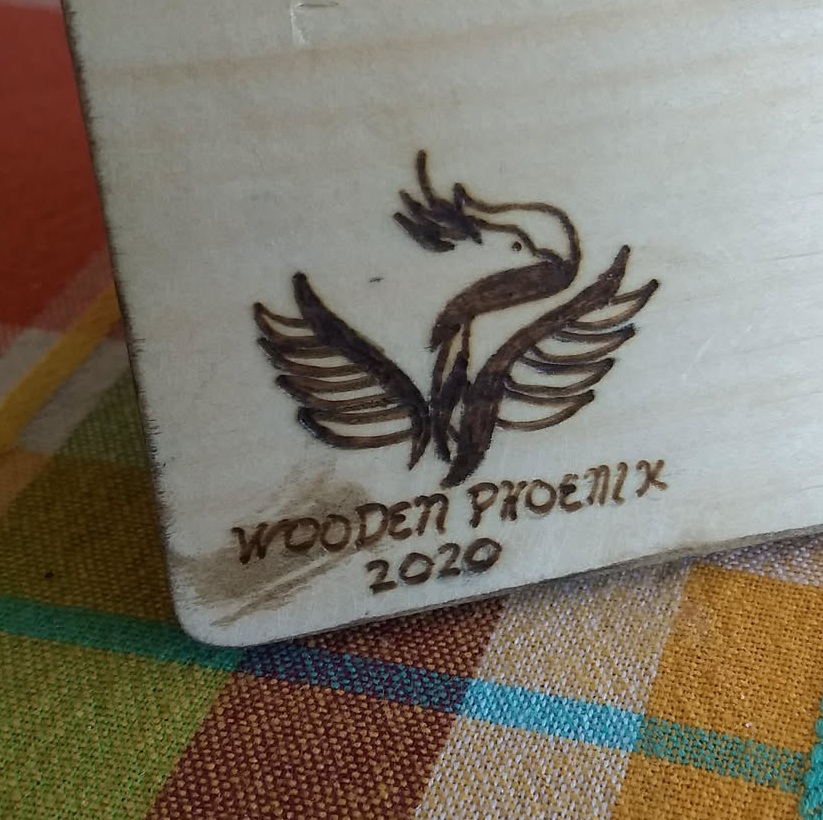
I've been asked where my shop name comes from. It stems from the fact that I am a polycraft, and the name is the same as my Reddit name. At the time that I was choosing my Reddit handle, I was particularly heavy into pyrography (decorative wood burning) as well as quilting. I was trying to find a name that felt like it reflected both crafts, and that one came up either verbatim or pretty closely and it ended up being what you see now.<\p>
Fast forward a while, and I have ended up designing quite a few Phoenix quilts, and so the name has stuck. I've kept the "wooden" around mainly because it's been there since the beginning of my pattern designing, as a way to help people find me, and because I haven't necessarily come up with another name in the meantime.